What Is a Solar Feed-in-Tariff?

Published 9 July 20265 mins read

If you have solar panels, you’ve probably noticed a credit on your electricity bill for the energy your system sends back to the grid. That credit is your solar feed-in tariff, the rate your electricity retailer pays per kilowatt-hour (kWh) for any excess electricity you export.

More than 4 million Australian households now have rooftop solar. Feed-in tariff rates have shifted considerably in recent years, and knowing how they work can make a real difference to your electricity bill.

How a Solar Feed-In Tariff Works

Your solar power system generates electricity throughout the day. Your home draws on that energy first, and any excess solar electricity flows out to the electricity grid automatically. This exported electricity is what earns you a feed-in tariff credit.

A smart meter records both what you draw from the grid and what you send back to it. Your electricity retailer applies a credit to your account for every kWh exported, based on your agreed FiT rate. This rate is also known as a buyback rate.

That credit reduces your energy bill directly, rather than arriving as a separate cash payment. For residential solar customers in Australia, it is also not subject to GST.

The Difference Between a Solar Feed-In Tariff and a Solar Rebate

The solar rebate and a solar feed-in tariff are two separate incentives. The rebate, delivered through the Small-scale Renewable Energy Scheme (SRES), reduces what you pay upfront for a solar power system. Most Australian rooftop solar installations qualify, and you receive the discount at the point of purchase.

A solar feed-in tariff is an ongoing credit for the renewable energy your system exports to the grid after installation. The SRES rebate is scheduled to run until 31 December 2030, while feed-in tariffs are set by electricity retailers and continue beyond that date.

What Are Solar Feed-In Tariff Rates Across Australia Right Now?

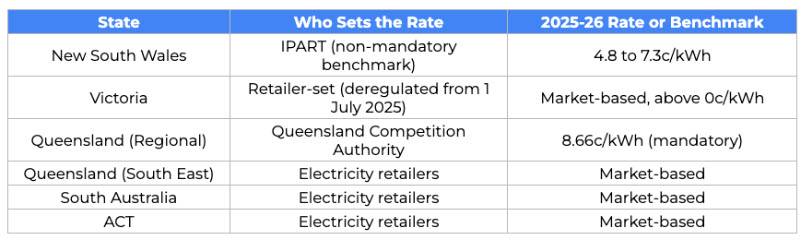
Feed-in tariff rates vary between states and electricity retailers. Most plans across Australia’s deregulated markets currently offer between 3 and 10 cents per kWh.

Sources: IPART, Essential Services Commission, Queensland Competition Authority. Rates current from 1 July 2025.

For a detailed look at current retailer offers, GoSwitch tracks solar feed-in tariff rates by state across NSW, VIC, QLD, SA, and the ACT.

Why Feed-In Tariff Rates Have Dropped

The more rooftop solar panels connected to the electricity grid, the more solar generation floods it during daylight hours. This pushes wholesale electricity prices down at precisely the time solar customers are exporting, which reduces what energy retailers pay for that electricity.

Early feed-in tariff rates were high because solar systems cost significantly more to install. The Clean Energy Council reports rooftop solar now accounts for 12.8% of Australia’s electricity generation. That figure has nearly doubled since 2020, which is largely what pushed FiT rates down.

Fixed-Rate vs Time-Varying Feed-In Tariffs

There are two main feed-in tariff structures, and the difference comes down to time of day.

  • Fixed-Rate Feed-In Tarrif – Also known as single-rate FiT, this pays the same cents per kWh for every solar export, regardless of the time of day. This suits households with consistent solar generation and limited flexibility to shift energy usage.
  • Time-Varying Feed-In Tariff – Time-varying FiT pays different rates depending on when you export. Rates are lower during off-peak midday hours when solar generation peaks, and higher in the late afternoon and evening during peak demand.

You need a smart meter to access a time-varying FiT. IPART notes that time-of-day benchmarks in NSW can exceed 20c/kWh during evening peak demand hours.

Does Adding a Battery Change Your Feed-In Tariff?

Adding a battery to your solar power system reduces your daytime solar exports. Instead of sending excess energy to the grid for a FiT credit, it stores that electricity for self-consumption later in the day. This means fewer credits on your electricity bill.

Stored solar electricity used in the evening offsets grid power at peak retail rates. This typically delivers more value than exporting for a low FiT credit. The Australian Government’s Cheaper Home Batteries Program has offered around a 30% discount on eligible systems since 1 July 2025.

What to Look at Beyond the Feed-In Tariff Rate

A high feed-in tariff rate does not always signal the best plan. The usage rate, daily supply charge, and export limits your retailer sets can each offset what looks like a generous FiT.

  • The usage rate you pay per kWh from the grid typically sits between 25 and 35 cents, well above most FiT rates.
  • Your daily supply charge applies regardless of how much solar electricity you generate.
  • Some electricity plans cap the kWh eligible for FiT credits each day through daily export limits.
  • Some energy retailers set inverter eligibility conditions on solar power systems.
  • Contract terms, including exit fees and benefit periods, affect the total value of a plan.

Self-consumption remains the most effective strategy. Running the washing machine or dishwasher during the day means your solar energy directly offsets grid electricity at the full retail rate. IPART confirms most solar customers gain more from using their own generation than from exporting it.

GoSwitch compares energy plans across NSW, VIC, QLD, SA, and the ACT, showing usage rates, supply charges, and FiT rates side by side. Compare solar plans with GoSwitch today and make sure your energy bill works as hard as your solar panels.


Leave a Reply